


Project Details
- Category Computer Vision in Digital Dermatology
- Date June 21, 2026
- rating
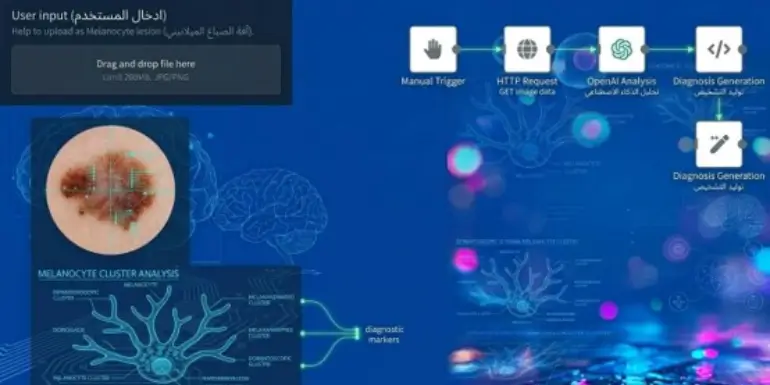
Skin Cancer Classification
Skin cancer, especially melanoma, can be life-threatening if not detected in its early stages. To address this critical challenge, we developed a powerful Convolutional Neural Network (CNN) model using DenseNet201 with Transfer Learning, a proven architecture in computer vision tasks.
The model is trained on thousands of clinically verified skin lesion images annotated by medical experts. It is capable of analyzing fine-grained visual features of skin lesions and classifying them into nine different categories.
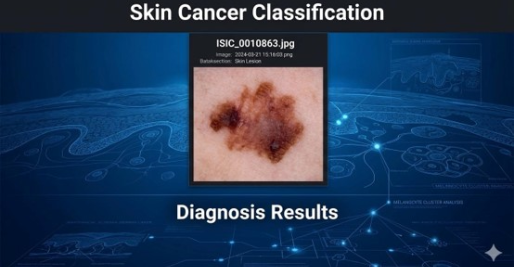
These include malignant conditions such as Melanoma and Basal Cell Carcinoma, as well as benign lesions like Nevus and Vascular Lesions. By learning subtle differences in color, texture, and shape, the model provides highly accurate predictions to assist dermatologists in clinical decision-making.
Project Tips
This project offers an efficient screening and diagnostic tool for dermatological conditions, enabling faster access to specialized care and improving treatment outcomes.
- Multi-class classification of nine different skin lesion types.
- Use of DenseNet201 with Transfer Learning for high accuracy.
- Fast image analysis compared to traditional diagnostic methods.
- Accurate differentiation between malignant and benign lesions.
- Instant and comprehensive classification results.
- Scalable and easily integrable as a clinical screening tool.
Overview & Challenge
The model analyzes skin lesion characteristics using multiple convolutional layers to extract geometric, color, and texture-based features.
The key innovation lies in Transfer Learning, where the pre-trained DenseNet201 model (originally trained on large-scale datasets like ImageNet) is fine-tuned on a smaller, specialized skin lesion dataset. This approach significantly improves accuracy while reducing training time and data requirements.
This makes the system highly effective even when some lesion categories have limited data.
The project represents an efficient use of data-driven AI, transforming raw medical images into actionable diagnostic insights in the field of dermatology.
Practical Implementation
The model can be used as a clinical decision-support tool for dermatologists by providing fast and accurate analysis of skin lesion images.
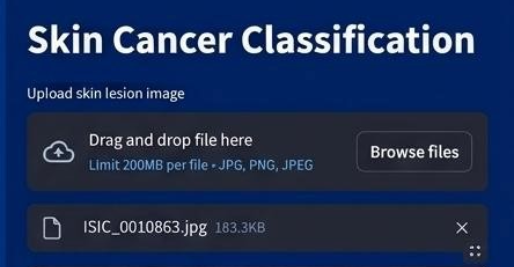
Its interactive interface allows both specialists and non-specialists to upload an image and receive an immediate classification result, supporting early detection and timely treatment of skin cancer.